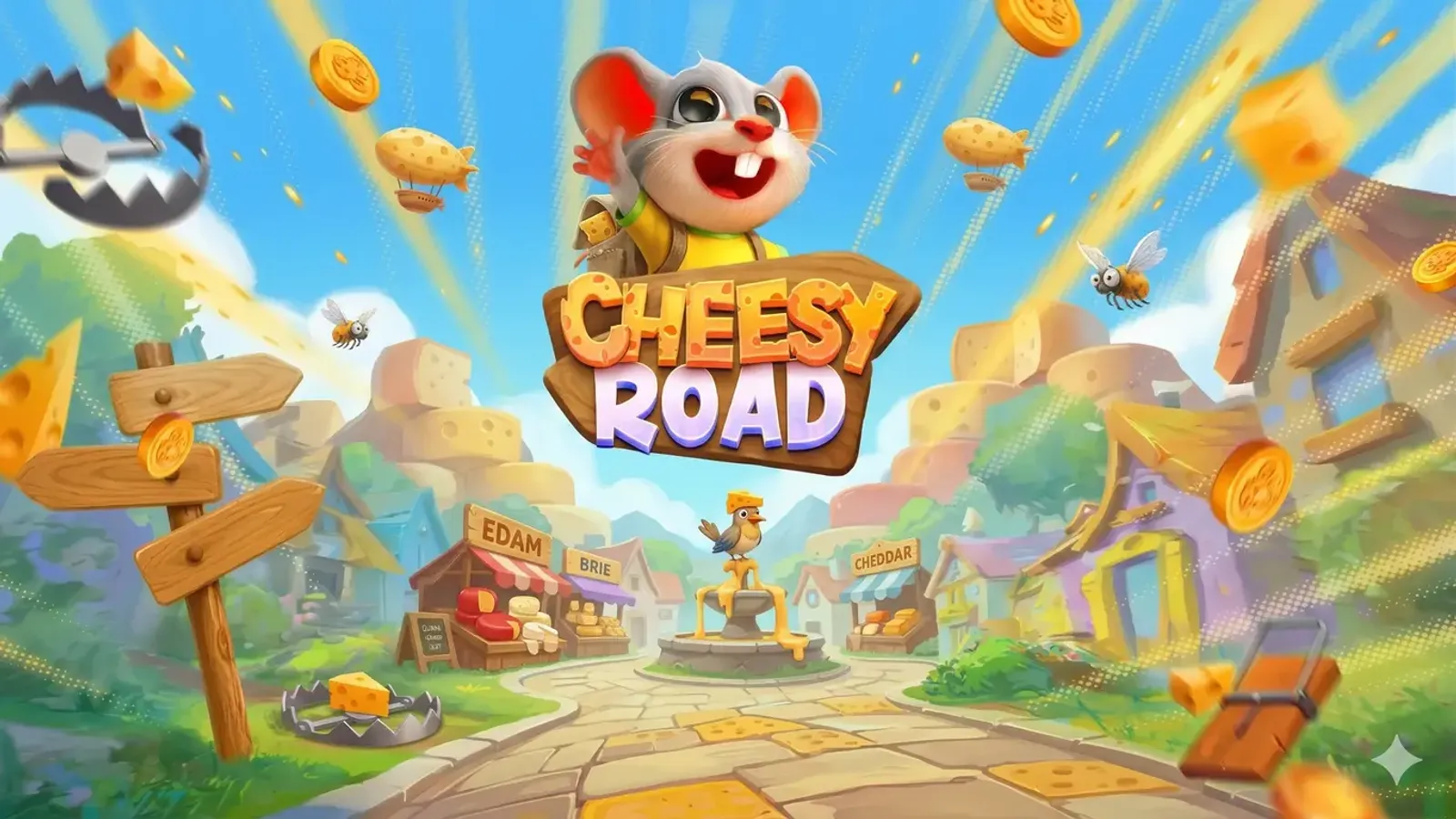
A Cheese Island Built on Minesweeper Nerves, Not Reel Spins
Cheesy Road is not a slot, and treating it like one is the fastest way to misjudge what it does. This is an instant mine-style, step-multiplier title from the crash category: a comedic cartoon mouse stands on one corner of a 13x13 island, the giant cheese prize sits diagonally across from it, and the whole space between the two is riddled with wooden mousetraps, live electric wires and molten lava tiles. There are no reels, no paylines, no wilds, no scatters. Every win in this game is the accumulated prize you personally chose to walk toward, and every loss is a trap you personally chose to risk stepping on.
That framing matters because it changes what kind of review this really is. A slot review asks whether the bonus round is generous. A Cheesy Road review has to ask something different: does giving the player full control over volatility, step by step, actually produce a better casino game than a fixed-math reel machine? We think the answer is yes, with real caveats, and this article explains exactly why.
Where Cheesy Road Sits Among Instant Games
Cheesy Road comes from SmartSoft Gaming, the studio founded in 2015 that built JetX, the flying crash game credited with defining the entire crash genre and played by more than 100 million people. SmartSoft’s portfolio runs past 100 titles across crash games, slots, keno and roulette, distributed through all major aggregators with software certified by independent testing laboratories. Cheesy Road is positioned as the studio’s follow-up to JetX in the instant-game space, and it earns that comparison by mashing up road-crossing crash mechanics with classic minesweeper logic on a free-roam grid.
The game launched in December 2025 as the first entry in what is now a small series. A companion title, Cheesy Road Classic, followed with a fixed-lane structure instead of free-roam movement, which tells you something about how the original was received: successful enough that the studio built a second version around the same core math rather than walking away from it.
Who This Game Actually Suits
Cheesy Road is built for players who want to make every decision themselves instead of waiting for a slot to hand them a bonus round. Route choice, the decision to take one more step, the moment you cash out — none of that is automated or scripted. If you find slot bonus-hunting passive and want a game where your own nerve is the mechanic, this is closer to what you are looking for than another five-reel title would be.
The Island, the Route Choices and the Traps
The playfield itself is the feature. Cheesy Road’s 13x13 grid puts the mouse in one corner and the x10,000 cheese in the far diagonal corner, and a zoom button pulls the camera back at any time to show the full island, your chosen route, and how many steps remain. Day and night display modes exist purely for visual comfort during longer sessions, letting you darken the ocean backdrop when you want the tiles themselves to stand out.
How Each Step Actually Works
At every step you are offered 2 to 3 tile choices, and each one carries its own prize tied directly to its own risk. On the very first step, for example, the safe tile toward the bottom corner pays around 1.05x, the medium tile toward the upper corner pays around 1.1x, and the risky diagonal tile straight toward the max-win corner pays around 1.5x. The pattern repeats at every subsequent step: the more dangerous the tile looks, the more it pays if it lands safely, and the route can be changed at every single move rather than being locked in upfront.
This is the detail that separates Cheesy Road from a typical mine game, where volatility is usually set once before the round starts. Here you are re-negotiating your risk appetite every few seconds, and that constant renegotiation is exactly what makes a session feel alive rather than mechanical.
The Prize Ladder and Corner Convergence
Every successful step reveals a higher prize, and the climb gets steep the closer the mouse gets to the far corner. The three routes settle into three very different ceilings:
- The safe route toward the bottom corner tops out at a total of 2x
- The medium route toward the upper corner tops out at 100x
- The full diagonal route toward the far corner ends at the x10,000 cheese
Here is the twist that catches new players off guard: once you reach the bottom or upper corner, only a single path forward remains. Corner convergence means your early choices don’t just set your current risk, they decide how much freedom you keep for the rest of the run. Head toward the safe corner early and you’ve capped your own ceiling at 2x for good. That is a real structural decision, not a cosmetic one, and it is worth thinking about before you make your first move rather than after.
What a Trap Actually Costs You
Traps vary with the route’s danger level — mousetraps, electric wires, lava, and other hazards populate the island depending on how risky the path is. Stepping on one ends the round immediately and forfeits every bit of accumulated, un-cashed prize you built up. There’s no partial save, no insurance, no second chance mid-round. This is the game’s sharpest edge: a ten-step chain that felt fantastic thirty seconds ago disappears completely the instant a trap tile is revealed, and that single rule is what gives every step its tension.
The Cash-Out Decision and Session Rhythm
Cash Out is the entire game distilled into one button. At any point between two steps, you can lock in the current accumulated prize, and once it’s cashed it is genuinely safe — it can never be taken back by a later trap. Everything else in Cheesy Road exists to feed pressure into this one decision: step again and chase a bigger number, or bank what you’ve got and start over.
What Playing a Round Feels Like
Rounds in Cheesy Road last seconds, and every one of those seconds is an active choice rather than a passive spin. There’s no reel animation to sit through, no anticipation hold for a bonus symbol — you’re either picking your next tile or deciding whether to bank. The rhythm sits closer to a strategy mini-game than to anything resembling slot spinning, and that’s deliberate. The tension comes specifically from pushing one more step against banking what you’ve already built, and that tension resets fresh every single round.
Controls You’ll Actually Use
The interface keeps things lean: a bet selector, 2 to 3 route arrows per step, the Cash Out button, the zoom overview, Autoplay with configurable parameters, and Turbo mode marked by a blue lightning icon that speeds up animation for players who don’t want to wait between steps. None of these controls exist to add features on top of the core loop — they exist to make the core loop faster or more comfortable to repeat, which is exactly what a step-multiplier game needs and nothing more.
No Bonus Rounds, and That’s the Point
Cheesy Road intentionally has no bonus games, free spins, wilds or side features. All of the excitement lives inside the step-or-cash-out loop and the route you personally chart. If you’re the kind of player who wants a slot’s free-spin round to break up the grind, this absence will feel like a gap. If you’d rather every moment of a session be a decision that matters, the minimalism reads as focus instead of a missing feature.
RTP, Volatility and What the Numbers Actually Mean
Cheesy Road runs at 97% RTP across all routes, which sits meaningfully above the typical 96% you’ll find on most reel slots. Over the long run, that means the game returns about 97% of everything wagered back to players collectively, while keeping roughly 3% for the house. It’s a better number than most of the market, but don’t mistake it for anything other than what it is: a long-term average across enormous volumes of play, not a promise about your next session, and still a negative expectation game no matter which route you favor.
Why the Risky Route Isn’t More Generous
Here’s the part players get wrong most often: the risky diagonal route doesn’t pay more because the game is being generous with it. All routes share the same 97% RTP. The diagonal pays more per step specifically because it fails more often — the higher prize is compensation for lower odds, not a bonus for bravery. That distinction matters because it kills the temptation to think you’ve found an angle by always choosing the dangerous tile. You haven’t found an edge. You’ve just chosen a different variance shape around the same underlying math.
What You Can Actually Know Before You Play
The per-step winning probabilities in Cheesy Road are not disclosed. You can see the prize sizes on offer, but not the odds behind them, so risk can only be inferred from how big a jump a tile promises. What you can rely on is this: every tile is an independent random event generated by the provider’s certified RNG, a safe run of five steps does not make the sixth step any safer or riskier, and the expected value of taking one more step is always slightly negative. Cash-out timing changes how much variance you’re carrying, not the underlying house edge sitting underneath it.
Reading the Route Trade-Off Honestly
| Route | Total Ceiling | Character |
|---|
| Safe, bottom corner | 2x | Slow to build value, near-1x early steps |
| Medium, upper corner | 100x | Middle ground, still converges early |
| Diagonal, far corner | x10,000 | Only route that keeps the max prize alive |
This is the honest weakness sitting inside an otherwise strong feature set. The safe route caps out at just 2x for the whole round, and near-1x early multipliers mean cautious play builds value painfully slowly. If you want the full x10,000 ceiling on the table, the diagonal is the only route that keeps it alive, and that’s a real trade-off you’re making with every early tile you pick, not a minor detail.
Starting a Session and Playing Across Devices
Getting into a round takes no setup beyond choosing a bet, which typically ranges from $0.10 up to $1,000 per round depending on configuration, though some operator setups cap the top end at $100. Once the bet is set, you start the round and begin picking tiles immediately — there’s no loading screen between decisions, no animation you’re forced to sit through before your next choice matters.
Where the Game Actually Runs
Cheesy Road is built entirely in HTML5/JS, which means it plays directly inside desktop, tablet and mobile browsers with no download required. The build is lightweight, around 15 MB, so it loads fast even on a weak connection — a real practical advantage if you’re playing on mobile data rather than home wifi. If you want to try the mechanics without risking anything, the free demo runs the identical math with play money, which is genuinely the only legitimate way to get a feel for the route system before betting real money on it.
Mobile Play and the App Question
There is no native app for Cheesy Road, and there never has been — the game exists only as an in-browser HTML5 client, running inside mobile browsers and inside casino apps that carry the SmartSoft portfolio. You can pin the game page to your home screen as a shortcut for a fullscreen, app-like feel, and the math stays identical across every device. Be cautious of any APK file or app-store listing claiming to offer a standalone Cheesy Road app: none of those are official, and our mobile play breakdown goes further into what’s real and what isn’t in that space.
Mine-style games like this one attract an unusual amount of predictor and signal-selling noise, all of it claiming to reveal safe tiles before you commit to a step. None of it works. Trap positions are generated fresh by a certified RNG for every round, no external tool has access to the game server, and anyone selling a guaranteed safe path is selling nothing at all. If you’re curious about how these claims hold up under scrutiny, our predictor page walks through exactly why they fail on games built this way.
Playing With a Plan Instead of Impulse
The mathematics behind Cheesy Road rewards a small amount of discipline more than most step-multiplier games do, precisely because you’re the one making every decision. Deciding your cash-out target before the round starts — a fixed multiplier like 2x or 3x, enforced consistently — beats reacting in the moment when the prize number is climbing and your nerve is being tested in real time. The zoom overview is worth checking before you commit to your next jump too, since seeing how many steps remain puts the size of the next prize increase into real context rather than an abstract number.
Remember the corner rule before you commit early: once you reach the bottom or upper corner you’ve given up route choice for the rest of the run, so if flexibility matters to you later, it has to be protected earlier. Use the safe tiles to stretch a smaller bankroll and learn the island’s rhythm, and treat diagonal steps as money you’re genuinely prepared to lose, not money you expect back. Never chase a trap loss by doubling your next bet — that’s a martingale system applied to a game that is already running a negative long-term expectation, and it doesn’t fix the math, it just accelerates it. Autoplay with an auto-cash-out setting can help if you know you struggle to bank manually once a chain gets exciting, and setting deposit, loss and session-time limits before you start matters more here than in slower games, simply because rounds last seconds and total spend is easy to lose track of.
If you want a fuller structured approach to route selection and bankroll pacing, our strategy guidance covers the practical side of this in more depth. And if you’re still getting comfortable with the controls themselves, the rules and interface guide breaks down every button before you put money behind a decision.
Cheesy Road earns its place by handing genuine control to the player at every single step, something very few instant games actually commit to. The 97% RTP is solid, the x10,000 ceiling is real, and the free-roam island gives it more strategic texture than the average mine title. But the game is also honest about its trade-offs: one trap ends everything, the safe route is genuinely slow, and the constant cash-out decision will wear on you in a way that a slot’s autoplay simply never does. Play it knowing both sides, treat the maximum multiplier as entertainment math rather than a target, and set your limits before the first tile, not after the tenth.
And if you’re wondering whether Cheesy Road is legitimate at all, the answer sits in its provenance rather than in any marketing claim: it comes from SmartSoft Gaming, the studio behind JetX, with software certified by independent testing laboratories and outcomes generated by a certified RNG on every single step. That’s a real basis for trust. It’s also exactly why no predictor tool, route pattern, or betting system can turn this into something it isn’t — a game of chance where the house keeps its edge no matter which corner you’re chasing.